


What Is Shadow Work?
A Comprehensive Guide
Shadow work is the practice of identifying, examining, and integrating the disowned, rejected, or suppressed aspects of yourself that operate outside your conscious awareness—the parts you’ve hidden because they felt unacceptable, dangerous, or incompatible with who you believed you needed to be.
Key Take Aways
- Shadow work helps us discover the parts of ourselves we’ve been hiding since childhood—the qualities we learned weren’t acceptable but that never actually disappeared. These hidden aspects are quietly running our lives without us realising it.
- Our shadow shows up in patterns we can’t seem to break: the same relationship problems on repeat, sabotaging ourselves just before success, reactions that surprise even us, and the gap between who we want to be and how we actually behave.
- The process has four stages: recognising when our shadow is at work, understanding why we hid these parts away, accepting them without judgement, and finally integrating them so they stop controlling us from behind the scenes.
- This isn’t about fixing ourselves or becoming perfect. It’s about becoming whole—reclaiming the energy we’ve spent hiding parts of ourselves and finally having the freedom to live authentically.
- Shadow work is particularly powerful during major life transitions when our old identity stops fitting and we’re ready to stop performing who we think we should be and start living as who we actually are.
- Integration brings real shifts: more available energy, clearer choices, more authentic relationships, and the ability to build a life that actually fits our truth rather than someone else’s expectations.
Table of Contents
Understanding Your Shadow
These hidden aspects—your “shadow”—don’t disappear when you reject them. Instead, they continue influencing your behaviour from beneath conscious awareness. They create patterns of self-sabotage, repeating relationship dynamics, unexpected emotional reactions, and invisible barriers to the life you’re trying to build.
Shadow work is the deliberate process of bringing these aspects into conscious awareness, understanding why they were hidden, and reclaiming the energy and authenticity locked within them.
The Origins: Carl Jung and the Shadow
Swiss psychiatrist Carl Jung introduced the concept of the shadow in the early 20th century as part of his analytical psychology. Jung observed that as people develop a “persona”—the acceptable face they show the world—they simultaneously create a “shadow” containing everything that doesn’t fit that persona.
What makes Jung’s framework particularly valuable is his recognition that the shadow isn’t purely negative. It contains not only feared or shameful qualities, but also positive traits we couldn’t acknowledge: our power, creativity, sexuality, anger, ambition, or capacity for joy. Any quality that didn’t align with our family’s values, our culture’s expectations, or our developing self-concept became part of the shadow.
Jung considered shadow integration essential for what he called individuation—the process of becoming psychologically whole. He wrote, “One does not become enlightened by imagining figures of light, but by making the darkness conscious.” In other words, genuine transformation requires acknowledging what we’ve been avoiding.
How the Shadow Forms
The shadow doesn’t form all at once. It develops gradually throughout childhood and adolescence as you learn which parts of yourself are acceptable and which aren’t.
This process begins early. A child expresses anger and is punished or shamed. A girl shows her strength and is told she’s “too much.” A boy cries and learns that vulnerability makes him weak. A teenager’s enthusiasm is met with eye rolls and ridicule. Someone’s creativity is dismissed as impractical, their sexuality as shameful, their needs as selfish.
Each time a part of you meets disapproval, rejection, or punishment, you face a choice: keep expressing that part and risk losing love, safety, or belonging, or hide it away to stay accepted. For a child dependent on caregivers for survival, this isn’t really a choice at all.
So you adapt. You learn to be quiet instead of loud, compliant instead of questioning, small instead of powerful. You perform niceness to hide your anger, rationality to hide your emotions, independence to hide your needs. The rejected qualities don’t disappear—they get buried in the unconscious, where they continue to exist and influence you in ways you can’t see.
The shadow also forms through cultural and societal conditioning. Different cultures, religions, and communities have different rules about what’s acceptable. Ambition might be celebrated in one context and condemned as selfishness in another. Sexuality, pleasure, rest, emotional expression, even success—what gets shadowed depends heavily on the environment you grew up in.
By adulthood, most people are operating from a fraction of who they actually are. The rest is hidden in the shadow, waiting to be reclaimed.
How the Shadow Operates in Your Life
The shadow doesn’t stay quietly hidden. It makes itself known through specific, recognisable patterns:
Projection
You see in others what you can’t acknowledge in yourself. If you’ve shadowed your anger, you’ll notice how angry everyone else seems. If you’ve hidden your selfishness, you’ll be hypersensitive to it in others. What you judge most harshly in other people is often what you’ve rejected in yourself.
Triggering and Overreaction
Certain situations or people provoke reactions far more intense than the situation warrants. Someone’s comment sends you spiralling for days. A minor slight feels like a devastating rejection. These disproportionate responses signal that something in your shadow has been activated.
Self-Sabotage
You work towards a goal and inexplicably undermine yourself right before success. You commit to change and find yourself reverting to old patterns. Shadow aspects often carry beliefs like “I don’t deserve this” or “success isn’t safe,” causing you to sabotage what you consciously want.
Repeating Patterns
The same relationship dynamic plays out with different partners. You keep ending up in the same professional situations despite changing jobs. You attract the same type of friend, face the same conflicts, hit the same walls. Repeating patterns indicate shadow material running the show.
The Gap Between Values and Behaviour
You value honesty but find yourself lying in small ways. You believe in boundaries but consistently overextend yourself. You want authentic connection but keep people at arm’s length. When your behaviour contradicts your stated values, the shadow is often involved.
Sudden, Unexpected Aspects of Self
You have a flash of rage that frightens you. A sexual fantasy that shames you. An impulse that seems to come from nowhere. These aren’t foreign intrusions—they’re shadow aspects making themselves known.
What Shadow Work Is Not
Before going further, it’s important to distinguish shadow work from related practices that are often confused with it:
Shadow Work vs. Therapy
Shadow work can be therapeutic, but it’s not therapy. Therapy, particularly trauma-informed therapy, addresses psychological conditions, processes trauma, and treats mental health issues. Shadow work focuses specifically on integrating disowned aspects of self. Whilst there’s overlap, they serve different purposes and shouldn’t be used interchangeably. If you’re dealing with clinical depression, anxiety disorders, PTSD, or other mental health conditions, therapy with a licensed professional is appropriate.
Shadow Work vs. Spiritual Bypassing
Spiritual bypassing uses spiritual concepts to avoid dealing with difficult emotions or psychological wounds. It’s the tendency to jump to forgiveness without processing anger, to focus on “high vibration” whilst suppressing difficult feelings, or to use spiritual practices to escape rather than engage with inner work. Shadow work is the opposite—it insists on looking at what you’d rather avoid.
Shadow Work vs. Positive Thinking or Manifestation
Manifestation practices often focus on aligning thoughts, beliefs, and energy with desired outcomes. Shadow work asks why those desired outcomes aren’t manifesting despite your efforts. It examines the unconscious beliefs, self-sabotaging patterns, and hidden loyalties that block what you’re consciously trying to create. You can’t manifest beyond what your shadow will allow.
Shadow Work vs. Self-Improvement
Self-improvement typically focuses on becoming “better”—acquiring new skills, optimising performance, or fixing perceived flaws. Shadow work isn’t about becoming better; it’s about becoming whole. It reclaims what was lost rather than adding something new.
The Process: How Shadow Work Actually Works
Shadow work isn’t a single technique but a practice that uses various approaches to bring unconscious material into awareness. Whilst the specific methods vary, the underlying process follows a consistent pattern:
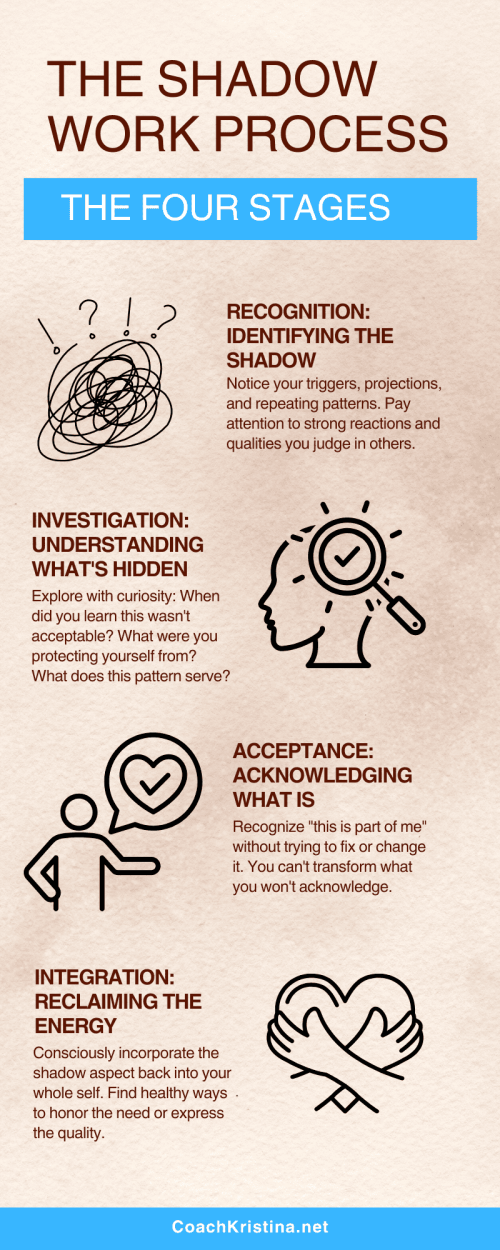
Stage 1
Recognition: Identifying the Shadow
The first step is noticing when shadow material is present. This requires developing awareness of your triggers, projections, and patterns. You begin paying attention to:
- Strong emotional reactions that seem disproportionate to the situation
- Qualities you consistently judge or criticise in others
- Patterns that repeat across different contexts or relationships
- Behaviours that contradict your conscious values or intentions
- Parts of yourself you feel compelled to hide or deny
- Dreams, fantasies, or intrusive thoughts that disturb you
Recognition often begins with discomfort. Something doesn’t feel right, doesn’t make sense, or keeps happening despite your best efforts to change it.
Stage 2
Investigation: Understanding What’s Hidden
Once you’ve identified potential shadow material, the next step is exploring it with curiosity rather than judgement. This involves asking questions like:
- What quality or aspect of myself am I rejecting here?
- When did I learn this part of me wasn’t acceptable?
- What was I trying to protect myself from by hiding this?
- What do I believe will happen if I acknowledge this part of myself?
- What has this pattern been trying to accomplish or protect me from?
This stage requires honesty and a willingness to sit with uncomfortable truths. You’re not trying to fix or change anything yet—you’re simply trying to understand what’s actually happening beneath the surface.
Stage 3
Acceptance: Acknowledging What Is
This is often the most challenging phase. Acceptance means acknowledging the shadow aspect without immediately trying to change, fix, or spiritualise it away. It means saying, “Yes, this is part of me” even when it contradicts your self-image.
This isn’t about condoning harmful behaviours or deciding everything about you is fine as it is. It’s about recognising that you can’t transform what you won’t acknowledge. The part of you that’s selfish, angry, needy, afraid, controlling, or wounded doesn’t disappear because you pretend it doesn’t exist. It just operates outside your control.
Acceptance creates the conditions for actual change because it stops the exhausting work of maintaining the denial.
Stage 4
Integration: Reclaiming the Energy
Integration is where the transformation happens. It’s the process of consciously incorporating the shadow aspect back into your whole self. This doesn’t mean acting out every impulse or expressing every hidden quality without discernment. It means:
- Acknowledging the quality exists within you
- Understanding its origin and what it was trying to protect
- Recognising the legitimate need or strength it contains
- Finding conscious, healthy ways to honour that need or express that quality
- Allowing it to inform your choices rather than control them unconsciously
When anger is integrated, you can set boundaries without rage or passive aggression. When neediness is integrated, you can ask for support without shame or manipulation. When your shadow ambition is integrated, you can pursue success without sabotaging yourself or pretending you don’t care.
Integration returns energy that was locked up in suppression and adds dimension to who you are. You become more whole, more authentic, more capable of conscious choice.
Common Shadow Aspects and How They Manifest
Whilst everyone’s shadow is unique to their experience, certain aspects appear frequently, particularly for women navigating midlife transitions:
The Selfish Self
Years of prioritising others’ needs—children, partners, employers—create a shadow self that wants, desires, and puts herself first. This aspect emerges as guilt when you take time for yourself, resentment towards those you serve, or an inability to identify what you actually want because you’ve suppressed it so thoroughly.
The Angry Self
Nice girls don’t get angry. Good women don’t rage. Decades of suppressing anger creates a shadow that expresses itself through passive aggression, depression (anger turned inward), sudden explosions over minor issues, or chronic resentment that colours everything.
The Ambitious Self
If you learnt that ambition was unfeminine, selfish, or threatening to others, your drive went underground. It might emerge as judgement of successful women, as self-sabotage when you get close to achievements, or as a vague dissatisfaction you can’t name.
The Sexual Self
When sexuality was shamed, made dangerous, or reduced to duty, the vital, pleasure-seeking aspect of yourself went into shadow. This can manifest as complete disconnection from your body, inability to experience pleasure, or shame around desires that are perfectly natural.
The Vulnerable Self
If showing need, fear, or uncertainty was met with punishment or exploitation, you learnt to hide vulnerability behind competence, independence, or strength. The shadow vulnerable self creates exhaustion from never being able to rest, difficulty receiving help, and isolation from genuine connection.
The Powerful Self
Women especially learn to dim their power, make themselves smaller, soften their voices, and defer to others. The shadow powerful self emerges as frustration with your circumstances, attraction to powerful people (projection), or sudden moments where your power breaks through in ways that frighten you.
The “Bad” Mother
The shadow holds the parts of motherhood that aren’t celebrated—the moments you resented your children, wanted your old life back, felt trapped, or simply didn’t enjoy being a mother. This aspect creates immense guilt and prevents honest reckoning with what motherhood actually cost you.
Practical Approaches to Shadow Work
Whilst detailed techniques vary, the essential practices that make shadow work effective include:
Journaling with specific inquiry: Writing in response to questions like “What am I most afraid people will discover about me?” or “What quality do I most judge in others?” Different from general journaling, this involves targeted questions designed to surface unconscious material.
Working with triggers: Rather than avoiding what triggers you, deliberately examining those reactions as messengers. When someone or something provokes a strong response, asking “What part of myself am I seeing reflected here?”
Dream analysis: Dreams often contain shadow material presented symbolically. The figures you fear or judge in dreams frequently represent disowned aspects of yourself.
Body awareness: The shadow often reveals itself through physical sensations—tension, constriction, numbness, or activation in specific situations. Learning to track these somatic responses provides direct access to unconscious material.
Guided processes with a practitioner: Working with someone trained to hold space for shadow work provides safety and guidance that’s difficult to achieve alone, particularly when approaching deeply buried or traumatic material.
The key across all approaches is creating enough safety to look at what you’ve been avoiding whilst maintaining enough challenge to actually engage with uncomfortable truths.
When Shadow Work Is Appropriate (and When It Isn’t)
Shadow work is powerful, but it’s not appropriate for every situation or every person at every time. Understanding these boundaries is essential for safe and effective practice.
When Shadow Work Is Appropriate:
Shadow work is well-suited for people who:
- Have developed enough ego strength to examine difficult material without fragmenting
- Are experiencing repeating patterns they genuinely want to understand and change
- Feel ready to take responsibility for their unconscious patterns rather than remaining in victimhood
- Have basic emotional regulation skills and can tolerate discomfort without becoming overwhelmed
- Are willing to question their self-concept and sit with ambiguity
- Have adequate support systems in place
It’s particularly valuable during major life transitions—when old identities no longer fit and repeating patterns become undeniable.
What Happens After Shadow Work: The Integration Phase
Shadow work isn’t a one-time event. It’s an ongoing practice of becoming more conscious, more whole, more authentic. But there are recognisable shifts that happen as shadow aspects become integrated:
Decreased Reactivity
Situations that once triggered intense reactions become more neutral. You can observe what’s happening without being hijacked by it. This doesn’t mean you stop having feelings—it means your responses become more proportionate and conscious.
More Energy Available
The energy that went into suppressing, denying, and managing shadow aspects becomes available for actually living. People often describe feeling lighter, more vital, or simply less exhausted.
Authentic Relationships
As you stop hiding parts of yourself, your relationships shift. Some deepen because you’re bringing your whole self rather than a carefully curated version. Others end because they were based on the false self you were performing. Both outcomes serve your wholeness.
Increased Choice
Instead of being run by unconscious patterns, you develop the ability to choose your responses. The shadow aspects are still there, but they’re no longer in control. You can acknowledge anger without being consumed by it, recognise neediness without being driven by it, feel ambition without sabotaging it.
Integration of Opposites
You become capable of holding paradox. You can be both strong and vulnerable, ambitious and content, independent and connected. The rigid either/or thinking that created the shadow in the first place gives way to both/and integration.
Alignment Between Inner and Outer Life
The gap between who you are and who you present yourself to be narrows. This doesn’t mean you share everything with everyone—it means you’re no longer performing a version of yourself that requires constant maintenance.
Compassion for Others
As you integrate your own shadow, you naturally develop more compassion for others. You recognise that everyone is carrying their own hidden aspects, fighting their own battles with what they can’t acknowledge. Judgement softens into understanding.
The Relationship Between Shadow Work and Living Authentically
Ultimately, shadow work serves a single purpose: reclaiming your wholeness so you can live as who you actually are rather than who you believed you needed to be.
You’ve spent years—perhaps decades—performing acceptable versions of yourself. You’ve achieved what you were supposed to achieve, done what you were supposed to do. And yet something feels fundamentally wrong. You’re successful but not fulfilled. Connected but not known. Busy but not alive.
This discontent isn’t a problem to solve—it’s an invitation to reclaim what you lost along the way. The shadow work is what makes that reclamation possible.
When you integrate the rejected parts of yourself, you can finally identify and pursue what you actually want. You can set boundaries that protect your energy and dignity. You can build the life you’re meant to live without apologising for it. You can take up the space you’re entitled to without shrinking to make others comfortable.
Shadow work doesn’t make you perfect. It makes you whole. And wholeness is what allows you to live authentically—to show up as who you actually are, to build a life that fits your truth rather than someone else’s expectations, to connect with yourself and others from a place of genuine presence rather than performance.
This is why shadow work matters. Not because it makes you more evolved or more enlightened. Because it makes you more you.
Want to know more and see how shadow work could help you free yourself and live more authentically?
Book a Discovery SessionCite This Article
If you found this guide helpful and want to reference it in your own work, here’s how to cite it:
APA Format:
Day, K. (2025). What is shadow work? A comprehensive guide. Coach Kristina. https://coachkristina.com/what-is-shadow-work
MLA Format:
Day, Kristina. “What Is Shadow Work? A Comprehensive Guide.” Coach Kristina, 2025, coachkristina.com/what-is-shadow-work.
Chicago Format:
Day, Kristina. “What Is Shadow Work? A Comprehensive Guide.” Coach Kristina. 2025. https://coachkristina.com/what-is-shadow-work.